"Duo sunt quibus principaliter mundus hic regitur."—Pope Gelasius I to Emperor Anastasius
For a vivid introduction to the conflict between Church and State, please watch the following excerpts from Becket:
[Part 2] [Part 3 (to 01:15)] [Part 5 (from 1:16)] [Part 6] [Part 7] [Part 8] [Part 9] [Part 10]
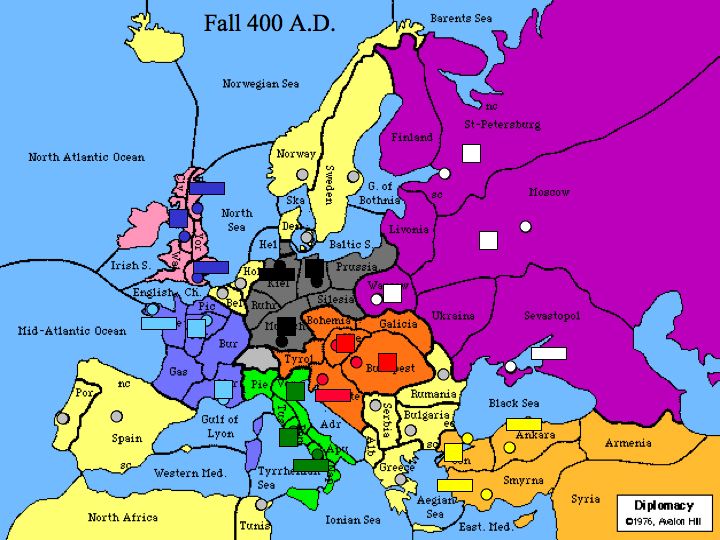
This version of Diplomacy uses Diplomacy Rules but amends them according to Dr. Morrissey's "Duo Sunt" Diplomacy Variant:
The "Duo Sunt" Variant = The Fall of Rome Diplomacy Variant + "The Papacy Rules" v2.0 Addendum (see details below)
The usual abbreviations for order submissions are valid and preferable.
"The Papacy Rules" Addendum (version 2.0 by Dr. C. S. Morrissey):
Classroom simulation: 7 players are named as Rulers (who may refer to themselves by these equivalent titles: King, Queen, Prince, or Princess), who shall each be associated with Vienna, London, Paris, Berlin, Rome, Moscow, and Constantinople; 15 players are named as Lords (who may refer to themselves by these equivalent titles: Duke, Duchess, or Lady), who are associated with the remaining territories; the remaining players are named (and considered ordained) as Bishops—and 1 of these is the Bishop of Rome (i.e., the Pope). The number of Lords and Bishops can be varied, depending on class size. The Pope assigns each one of the bishops to a territory. The Pope must name at least seven of these bishops as cardinals before the historical simulation begins; usually he will name as cardinals some bishops whose territories are supply centers.
Order submission protocol: At least one team member of a great power must sign the submitted orders for them to be valid. In a dispute about which is the valid set of orders submitted by a team, the signature of a Ruler is considered to overrule orders signed by any number of Lords. The signature of a bishop has no power other than to convene an ecumenical council with other bishops, or to vote in a papal election. Only the signature of the Bishop of Rome can ratify excommunications and "punishment of heretics and apostates" (interdictions). The class participation grade is determined by the number of turns on which a player's authentic signature appears.
"The Papacy Rules" Addendum to Diplomacy:
1. The Pope has the power of excommunication: the Pope can ban any player from speaking with other teams' players (i.e., an excommunicated player is banned from communication with players who belong to the team of another great power). The ban remains in effect until the excommunication is lifted by a Pope.
2. Bishops who have no team affiliation with one of the seven great powers, or whose territory has not yet been occupied, cannot speak to anyone if they are excommunicated.
3. The Pope also has the power of "punishment of heretics and apostates" (interdictions): an excommunicated player who is caught communicating can be temporally "punished" by the Pope; i.e., a single specified army or fleet associated with the excommunicated player's team is immobilized for two turns (i.e., a Spring turn and a Fall turn), but only if that army or fleet is explicitly named in writing by the Pope on both turns.
4. If an excommunication is lifted, any "punishments of heretics and apostates" associated with that excommunication are also immediately nullified.
5. The Pope resides in Rome, but if Rome is captured, the Pope may be deposed by the occupying power: this then automatically triggers a conclave, which requires the cardinals to vote once per turn until a new Pope is elected. A majority vote in this automatically triggered conclave will promote any other bishop (usually a cardinal, but at least a bishop) to accede the papal throne as the new Pope. (Note that any power that does occupy Rome may find it politically wiser to foster diplomatic collaboration with the Pope rather than to depose him; see Rule #17 below.) Conclaves last for as many turns as it takes to elect a new Pope. Cardinals submit one vote per turn, during the Order Writing Phase.
6. If an ecumenical council elects a new Pope when the current Pope has not been deposed by an invading power, then the newly elected Pope is defined as an Anti-Pope. Only a bishop assigned to a territory with a supply center can be named an Anti-Pope.
7. A bishop is considered to be anyone ordained as bishop before the first turn. Popes can ordain bishops later on, but they must do so in writing, assigning them to a territory, and the ordination is not in effect until the turn after the written ordination has been submitted. The Pope is the bishop of Rome. The Pope must name at least seven bishops as cardinals before the first turn.
8. A bishop can declare affiliation with a great power team before his territory is occupied; but once his supply center is occupied, he is considered to be affiliated (whether he likes it or not) with the occupier, and therefore if he is excommunicated then he cannot lawfully communicate with any other teams or bishops apart from those who are affiliated with his occupier. (Bishops who do not declare affiliation should keep in mind Rule #2 above.)
9. Whether or not the Pope's approval is required to ordain new bishops is for the players of the game to decide in their diplomacy. An ecumenical council, or the emperor, may wish to weigh in on such a grave matter.
10. Anti-Popes may be deposed when the supply center in which they have been ordained (i.e., to which they were named as bishop and in which they are now considered to be residing during their time of alleged "exile" from Rome) has been captured by another power. Anti-Popes must be deposed by an explicit order of the occupying power.
11. Orders of excommunication or "punishments of heretics and apostates" submitted by Anti-Popes have no effect other than moral suasion. Presumably an Anti-Pope will wish to incite temporal powers to depose the current Pope and thereby validate the election of the Anti-Pope and all his outstanding decrees.
12. "Punishments of heretics and apostates", excommunications, and the lifting of excommunications are made official by being submitted in writing by the Pope during the Order Writing Phase.
13. Evidence of communication by an excommunicated player must be documented (or simply plausibly argued for) and submitted in the form of written testimony by the Pope. The decision of the Diplomacy Judge during the Order Resolution Phase is final; his decision alone will settle any disputed cases of unlawful communication being imputed to an excommunicant. The Diplomacy Judge must above all act as a referee to maintain a spirit of fair play and sportsmanlike conduct.
14. The only excommunicated players who may lawfully communicate with other players are validly ordained bishops, but only on one condition: viz., if an ecumenical council has been convened. An ecumenical council is considered as convened for two turns if a majority of bishops sign a written decree that an ecumenical council has been convened. Ecumenical councils may convened at any time during the Diplomacy Phase.
15. An excommunicant who fails in his attempt to convene an ecumenical council runs the risk of having any of his team's forces named under "punishment of heretics and apostates", because even the act of requesting other players to participate in an ecumenical council is considered to be an act of communication. However, if he succeeds, then his communication is considered as having been lawful.
16. The Pope has the power to crown or to depose an emperor at any point during the game, but this has no practical effect other than moral suasion. An ecumenical council has the power to elect a new Pope, but only if a conclave has not been triggered and only if the Pope resigns; otherwise, the council may only elect Anti-Popes. The votes of excommunicated bishops do not count towards election of a Pope; but they do count towards the election of an Anti-Pope. A council cannot depose a Pope. Popes can resign, but only in writing and never under duress.
17. The deposing of a Pope can be ordered by the invader during the same turn's orders on which a move into Rome is made, or on any turn thereafter in which the invader still occupies Rome. Deposing of a Pope is thus ordered by an invader when orders are written and, if occupation is successful, the deposing is enacted during the Order Resolution Phase (making null and void any excommunication or punishment orders from the Pope received on or before that turn).
18. No great power's team may be said to have won the game unless it is in communion with Rome. This does not necessarily mean that Rome is occupied by the winning power. As long as its Ruler is not under a ban of excommunication at the time of the Order Resolution Phase, then it may win the game by achieving capture of the requisite 18 supply centers.
19. "As you see, O august Emperor, there are two by which this world is
principally governed: the authority of the sacred Pontiff, and the royal power.
Between these two the greater burden is that of the priest, as indeed he will
have to render an account for the kings of men regarding divine matters. A few
small points on this:
§ 1. Among these things you know that you are to listen attentively to
judgments from the priests, and not to those things which are rendered by your
own will.
§ 2. Supported by many great customs and a good many authorities the Pontiffs
have excommunicated both kings and emperors.
For instance, if a few specific examples of princes are required, [I offer these].
Pope Innocent excommunicated Emperor Arcadius because he had conspired to drive
out St. John Chrysostom from his see. Also Ambrose, thought to be holy yet not
the bishop of the Universal Church, did not seem to the other priests to be
oppressive when he excommunicated Emperor Theodosius the Great for his faults
and excluded him from the Church.
Ambrose indeed pointed out in his own writings that because gold is not of such
great value if it is mixed with lead, how can the royal power be of higher dignity
than the sacerdotal? He wrote this rule around the beginning of his pastorate:
Brothers, honor the sublimity of the episcopate for nothing is able to be adequately
compared with it. If the king is compared to the flashing of lightning and the
prince to preeminence, they will be far inferior, just as if lead is compared
to the glitter of gold. Obviously, since you see that the necks of kings and
the princes of the nations should be submitted to the priests, and indeed the
kings ought to pledge with their mouths that they will believe themselves to
be established by the priests's prayers."—Pope Gelasius I to Emperor
Anastasius
The Diplomacy "Duo Sunt" Variant (with its "The Papacy Rules" Addendum) was created by Dr. C. S. Morrissey. (Special thanks to Irene Cadrin, M.S., for her comments on Version 1.0.)